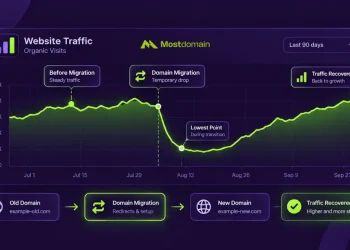

Why aged domains rank faster is one of the first things buyers want explained before spending real money on used domain. The short version: an aged domain shows up with signals a new site has to earn over many months, so search engines have less to verify before the contents starts surfacing. It is a head start, not a finish lines. The pages still have to be good.
A lot of confusion starts right here, though. Faster is not the same as higher, and old domain that sat idle for years brings almost nothing to the table. Both points matter, so let’s take them in orders.
Why Aged Domains Rank Faster?
Aged domains rank faster because they inherit earned signals like backlinks and trust, while the age number on its own adds nothing to rankings. The speed comes from history, not from the calendars.
- The inherited signals do the real work: backlinks, crawl history, and earned trust that travel with the domain, so a search engine has something to evaluate from day one instead of a blank slates.
- Age itself is not the cause. Google’s John Mueller has stated that domain age is not a ranking factor, which puts the credit on what the domain built, not on how long it existed.
- Even so, content decides the contest. A six-month-old domain with genuinely useful pages can outrank a ten-year-old domain full of thin ones.
- Strip it back and you are really buying a shorter runway, with the early trust-building already partly done, assuming the previous history is clean.
What “Ranking Faster” Actually Means for an Aged Domain
Ranking faster means a shorter amount of time to visibility, not a higher ceilings on where you finish. This distinction trips up most first-time buyers, so it is worth pinning down before you read any further.
Here is the split in plain terms:
- Speed is what an aged domain helps with. Indexation tends to happen sooner, and early rankings can appear in weeks instead of after a long quiet stretch.
- Position is what it does not promise. Where a page eventually lands still rides on content quality, relevance, and competition, same as any site on the web.
- The two get blurred constantly, which is where the disappointment comes from. People buy an aged domain expecting page one overnight, then blame the domain when a weak article underperforms.
So the honest framing is this. An aged domain compresses the waiting that a new site spends proving itself. It does not hand you a top spot you never earned.

The Signals an Aged Domain Already Carries
An aged domain ranks faster because of the value offour signals are already in place on day one, while a new domain starts every one of them from zero. Each signal shortens the gap between launching and actually showing up in results.
| Inherited signal | What it is | Why it speeds up ranking |
| Crawl and index history | A record of the domain being visited and stored by Google over time | Known domains get revisited more readily, so new pages are found and indexed sooner rather than sitting in line |
| Accumulated trust | Reputation built across years of being a legitimate, active site | Cuts down the early “is this real” assessment that holds fresh registrations back |
| Inherited backlinks | The profile of sites already pointing at the domain | Carries link equity a new site would otherwise spend months chasing through outreach. The deeper mechanics live in our guide to the SEO value of aged domains |
| Topical history | A track record of having covered a subject before | Relevance does not reset to nothing, so the domain re-enters familiar territory quickly |
One caveat belongs with that table and won’t fit inside it: every signal above is only an asset if it is clean. A backlink profile stuffed with spam is something you inherit too, and it works against you.
Aged Domains and the New-Site Delay
Aged domains rank faster in part because they skip the slow opening months that a brand new site has to wait out before search engines take it seriously. That early lags is where most of the speed gap actually lives.




- Most new domains needs three to six months to gains real traction on competitive keywords, even with strong content and a clean technical setup. That window is simply the price of being unknown.
- Google denies running an official “sandbox” that holds new sites back on purpose. Plenty of SEOs report a trust gap anyway, a stretch where a fresh domain barely moves while the algorithm gathers enough signal to judge it.
- Whether that lag is a deliberate filter or just the natural cost of building authority is its own debate, and the full version lives in our breakdown of whether aged domains bypass the sandbox.
- Walk an aged domain with a clean past into that same window and it already carries momentum, the kind a new site has to manufacture from scratch.
The Catch: Quick Rankings Are Never a Sure Thing
The supposed advantage of an aged domain is entirely conditional, you only get a fast start if the URL brings a spotless, highly relevant history to the table. If you run into a few specific roadblocks, your entire investment basically goes down the drain:
Neglected URLs are just registration dates
Buying an abandoned site is basically paying a premium for a brand-new one. If legacy links have rotted away and the old pages are long gone, there are zero ranking signals attached to it anymore.
Toxic baggage transfers directly to you
Garbage links carry right over to your new project. If the previous owner ran cheap spam blasts, you are simply buying their algorithmic suppression instead of positive link equity.
Niche mismatches waste good history
Taking a site famous for baking recipes and pivoting it to a finance blog is a massive waste. Post-2024 search algorithms will just get incredibly confused about what your digital property is actually supposed to be.
Correlation studies create false hype
Don’t misread stats like the classic Ahrefs data showing most top 10 results are over three years old. Raw age didn’t trigger those wins. Those URLs simply survived because their owners kept building great links and keeping the content useful year after year.
FAQ
Do aged domains always rank faster than new domains?
No. Age alone means absolutely nothing if the history is junk. Plenty of buyers learn that the hard way. Sure, an old URL packed with great, relevant links gives you a huge head start. But if you buy something that was penalized or spammed to death by the last owner? You are in a much worse position than if you just bought a brand new URL. It all comes down to the exact history you’re paying for.
How much faster can an aged domain rank?
Usually enough to let you skip that brutal three-to-six-month waiting period that new sites suffer through on competitive terms. I can’t give you an exact, fixed number of days, because every project is different. But a premium aged domain frequently shows real movement in just a few weeks. Meanwhile, a fresh site launched on the same day would still be struggling to get the post-2024 search algorithms to even notice it exists.
Is domain age a Google ranking factor?
Nope, not by itself. Google’s team has said time and time again that a registration date is just a number on a calendar, it’s not a direct ranking signal. The actual magic comes from the assets the domain built up over all those years. We’re talking about the inbound links, the established trust, and a deep topical history.
Does a huge domain authority guarantee a fast start?
Not even close. DA and DR are just rough estimates made by SEO tools, not actual Google metrics. I see people get blinded by a high score all the time, only to find out it was pumped up by completely useless, toxic links. Use those scores as a quick filter, but you always need to dig through the backlink data yourself before spending your budget.
Can a brand new site ever rank that fast?
It definitely happens. Find keywords nobody else is fighting for, build a great site, and you might actually get traffic rolling in a couple of weeks. The whole reason people pay a premium for aged domains is to survive in cutthroat niches. Trying to prove your worth from scratch in a crowded market just burns way too much time in 2026.
References
- Google Search Central, on domain age and ranking signals
- Ahrefs Blog, studies on domain age and time to rank in Google
- Moz, on domain authority and trust signals