Why do I need a domain name for my business comes down to one uncomfortable fact: without one, a business is renting its entire online identity from someone else, whether that’s a social media platform, a free website builder subdomain, or nothing at all. Rented space can be taken away, changed, or shut down without warning. Owned space can’t.
Most articles answering this question stop at a checklist of generic benefits, credibility, branding, SEO, and call it done. This one covers those same fundamentals, but also the honest cases where waiting makes sense, and a real way to weigh the cost against what’s actually at risk.
Nothing here strays into anything else domain-related outside this specific decision. Just what a domain does for a business, what happens without one, and whether now is actually the right time.
What Happens to Your Business Without One
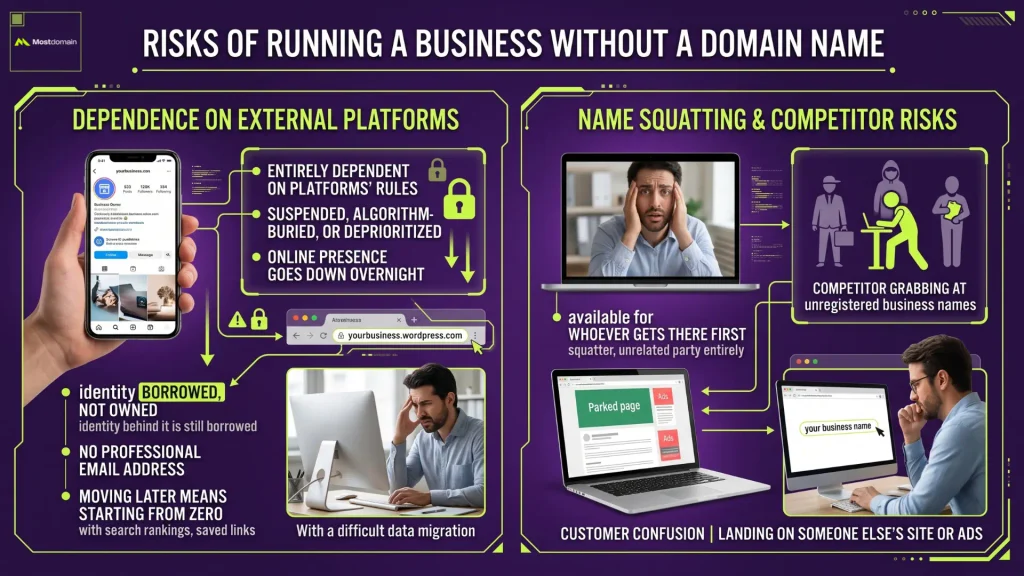
A business without a domain name depends entirely on platforms it doesn’t control, and that dependence carries real risk the moment any of those platforms change the rules.
Relying on Social Media or a Free Subdomain Instead
- A social media page depends entirely on someone else’s rules; get suspended, algorithm-buried, or deprioritized, and an entire online presence goes down with it overnight
- Slapping “yourbusiness.wordpress.com” or “yourbusiness.wixsite.com” on a business card tells visitors the identity behind it is still borrowed, not owned
- Neither option gives a business a professional email address matching its actual name
- Moving away from either platform later means starting over from zero with search rankings, saved links, and brand recognition
The Risk of a Competitor or Squatter Claiming Your Business Name
Leaving a business name unregistered as a domain doesn’t keep it safe, it just leaves it available for whoever gets there first, competitor, squatter, or unrelated party entirely. A customer typing in the obvious domain and landing on someone else’s site, or an ad, causes exactly the kind of confusion a business spent time and money building a name to avoid.
The Credibility Boost a Domain Gives You Instantly
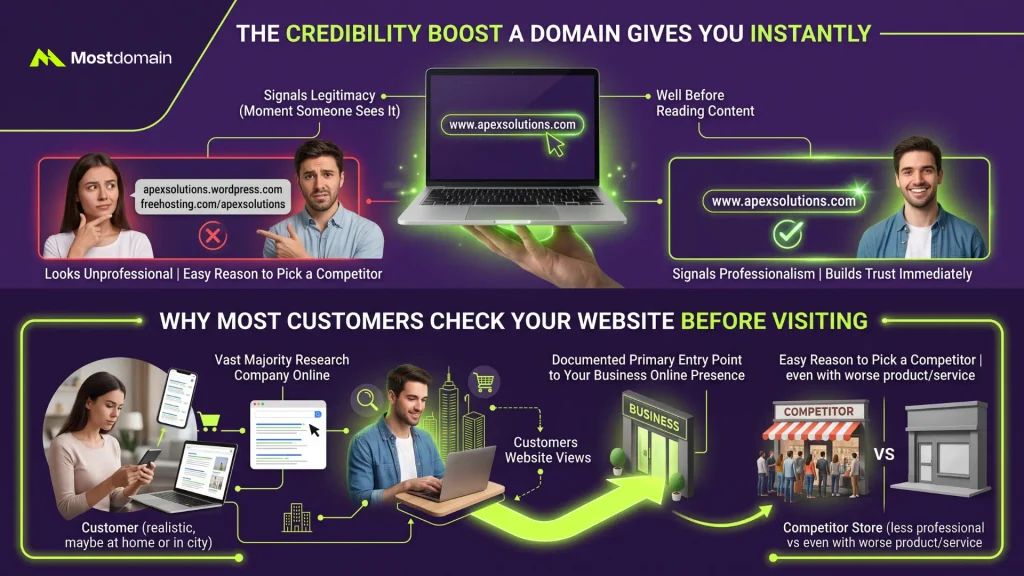
A custom domain signals legitimacy the moment someone sees it, well before they’ve read a single word of actual content on the site.

Why Most Customers Check Your Website Before Visiting
The vast majority of consumers research a company online before ever visiting in person or making a purchase decision, a pattern well documented in how domain names function as the primary entry point to a business’s online presence. A domain that looks unprofessional, or doesn’t exist at all, gives a hesitant customer an easy reason to pick a competitor instead, even one offering a worse product or service.
The Case for a Professional Business Email
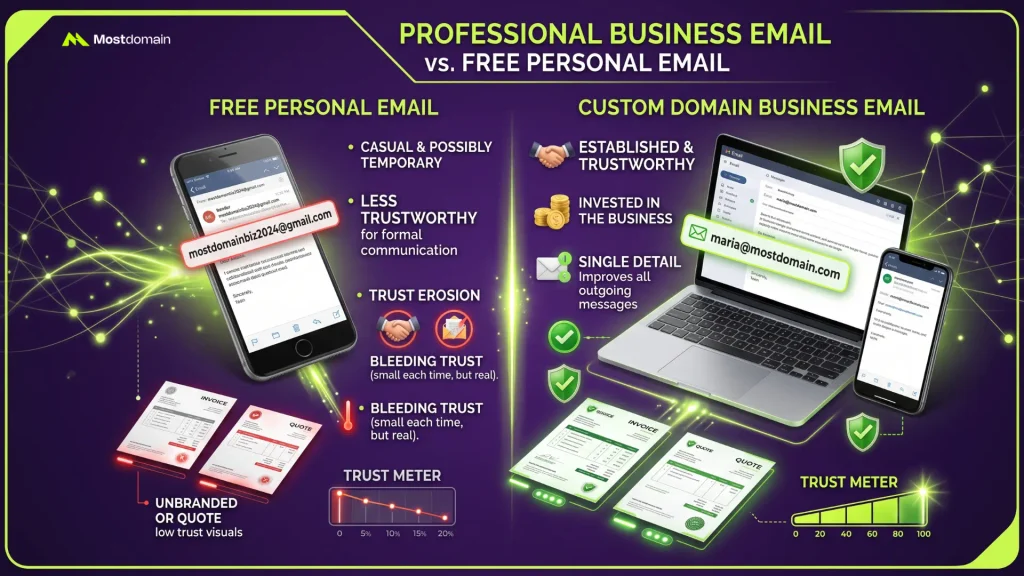
A domain name unlocks an email address that matches a business’s actual name, and that single detail changes how professional every single outgoing message looks.
[email protected] vs. a Free Email Address
| Email Type | Example | How It Reads to Customers |
| Custom domain email | [email protected] | Established, trustworthy, invested in the business |
| Free personal email | [email protected] | Casual, possibly temporary, less trustworthy for formal communication |
Every quote, invoice, or follow-up sent from a free personal address instead of one carrying the business’s own name bleeds a little trust, small each time, but real.




How Much a Domain Actually Helps With SEO
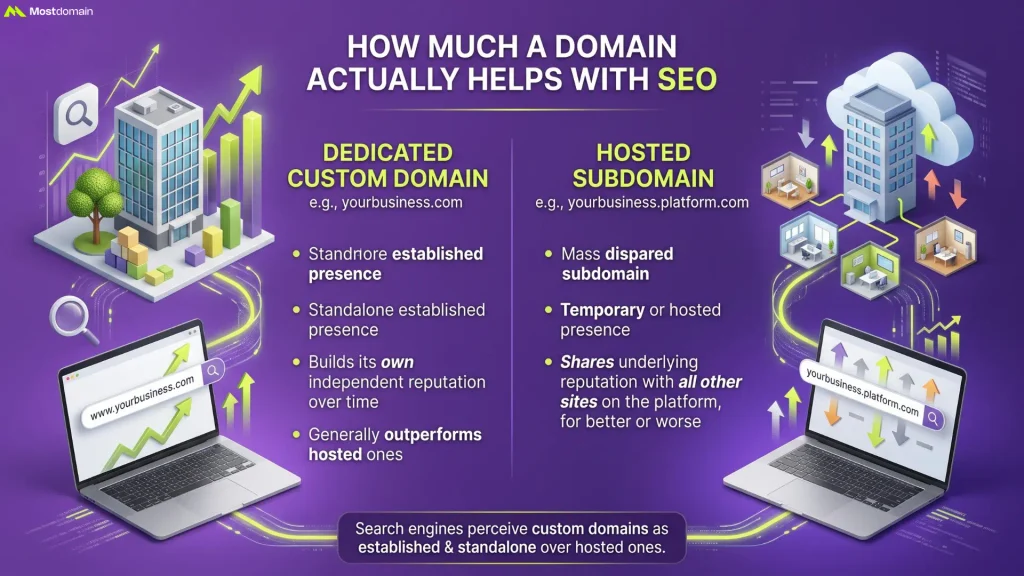
A dedicated domain reads to search engines as a standalone, established presence, not a temporary or hosted one, which is exactly why a clean custom domain generally outperforms a subdomain riding on someone else’s platform.
Custom Domain vs. Subdomain in Search Results
A subdomain shares its underlying reputation with every other site hosted on that same platform, for better or worse, while a custom domain builds a reputation entirely its own over time. Domain SEO covers exactly how domain choice interacts with ranking factors for anyone wanting the deeper technical breakdown of that relationship.
Protecting Your Business From Impersonation
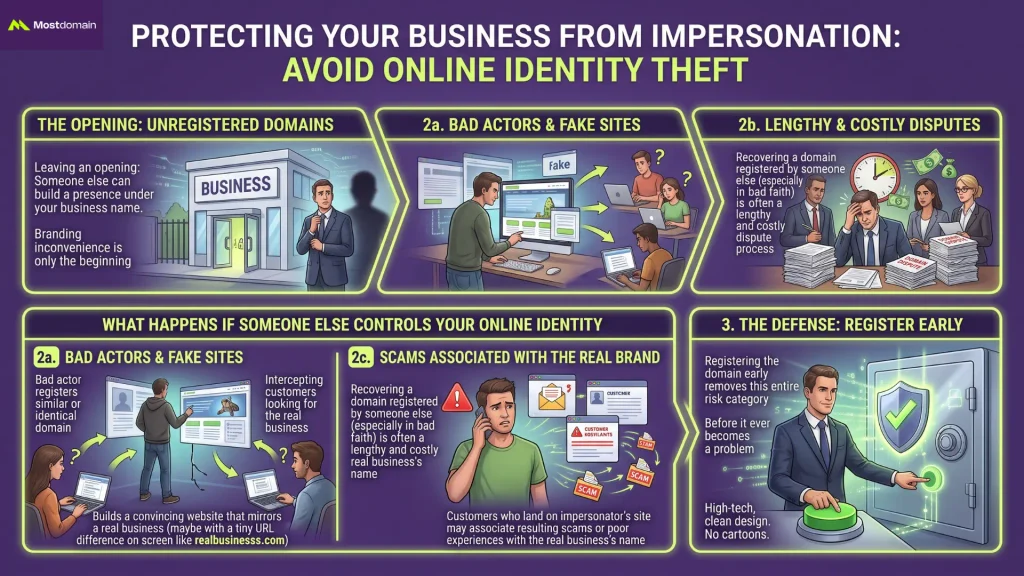
Not owning a domain leaves an opening for someone else to build a presence under a business’s name, and that risk goes well beyond a simple branding inconvenience.
What Happens If Someone Else Controls Your Online Identity
- A bad actor registering a similar or identical domain can build a convincing fake site, intercepting customers looking for the real business
- Recovering a domain already registered by someone else, especially in bad faith, often means a lengthy and costly dispute process
- Customers who land on an impersonator’s site may associate any resulting scam or poor experience with the real business’s name
- Registering the domain early removes this entire risk category before it ever becomes a problem
What Owning One Buys You Down the Road
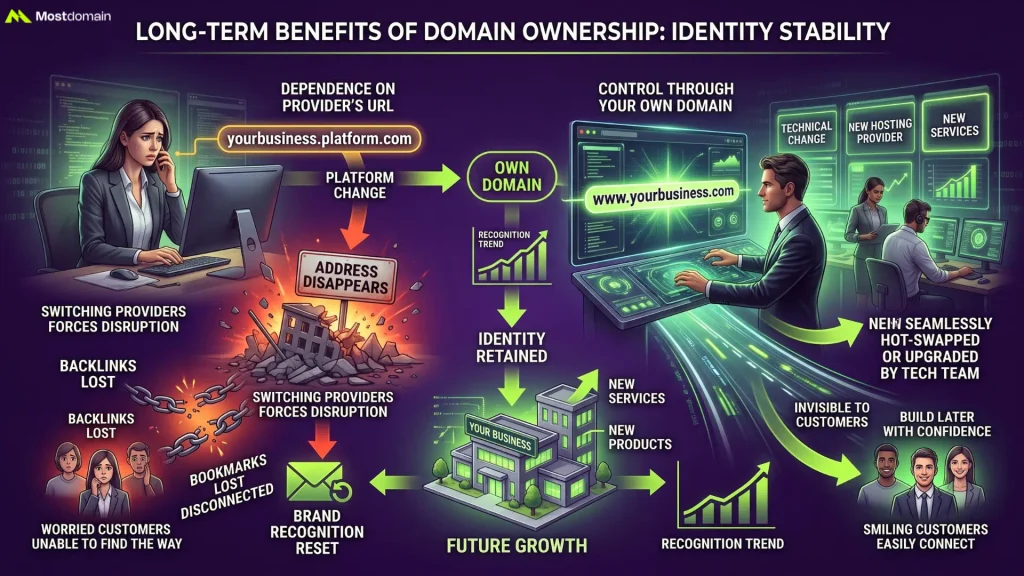
Restructuring a website, switching hosting providers, or launching new services without losing the identity customers already recognize, that’s what owning a domain actually buys a business over time.
Switching Platforms Without Losing Your Brand
Switch providers on a third-party platform, and the address disappears with it, forcing every customer, backlink, and bookmark to get updated or lost for good. A business running on its own domain never faces that reset. The hosting or platform underneath can change entirely, invisibly, while the address customers already know stays exactly where it was.
Do You Actually Need One Right Now
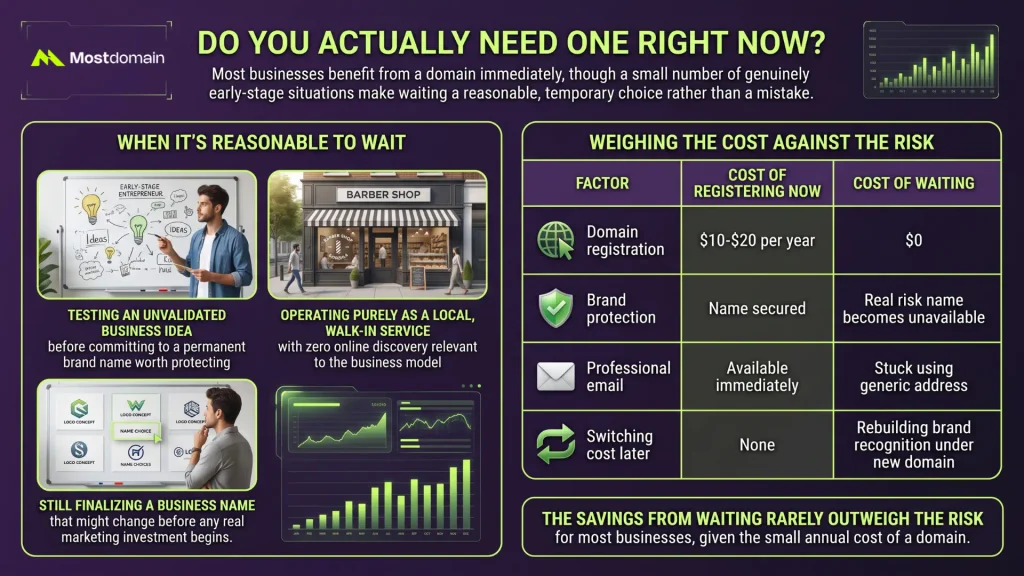
Most businesses benefit from a domain immediately, though a small number of genuinely early-stage situations make waiting a reasonable, temporary choice rather than a mistake.
When It’s Reasonable to Wait
- Testing an unvalidated business idea before committing to a permanent brand name worth protecting
- Operating purely as a local, walk-in service with zero online discovery relevant to the business model
- Still finalizing a business name that might change before any real marketing investment begins
Weighing the Cost Against the Risk
| Factor | Cost of Registering Now | Cost of Waiting |
| Domain registration | Roughly $10 to $20 per year for most standard extensions | $0, until someone else claims the name first |
| Brand protection | Name secured against squatters and competitors | Real risk the exact name becomes unavailable later |
| Professional email | Available immediately once registered | Stuck using a free personal or generic address |
| Switching cost later | None, already in place | Rebuilding brand recognition under a new domain if the original is gone |
The savings from waiting rarely outweigh the risk for most businesses, given how small the annual cost of a domain actually is.
FAQ
Can I just use a free website builder instead of buying a domain?
Technically, yes. The catch is the resulting address usually carries the platform’s own name as a subdomain, reading as less established to customers than a custom domain would.
How much does a domain name actually cost per year?
Somewhere between $10 and $20 annually covers most standard extensions, though pricing shifts by extension and occasionally spikes hard for short or high-demand names.
Do I need a domain if my business only operates on social media?
Worth owning one regardless. Social platforms can restrict, suspend, or shift their algorithms in ways completely outside a business’s control, while a domain answers to nobody but that business.
What happens if I wait too long to register my business name as a domain?
Someone else, a competitor, a squatter, an unrelated party entirely, can register it first. Getting a name back once it’s already claimed by someone else is often slow, expensive, or flat-out impossible.
Does a domain name matter if my business doesn’t sell anything online?
Yes, and the “no online sales” part doesn’t change that. Credibility, professional email, and discoverability all still run through the domain, since most customers research a business digitally long before making actual contact.
References
- Hostinger, Why do I need a domain name for my business?
- Beaming, Why does my business need a domain name?
- Bluehost, Why Do I Need a Domain Name? Key Benefits Explained
- Network Solutions, What is the purpose of a domain name for small businesses?