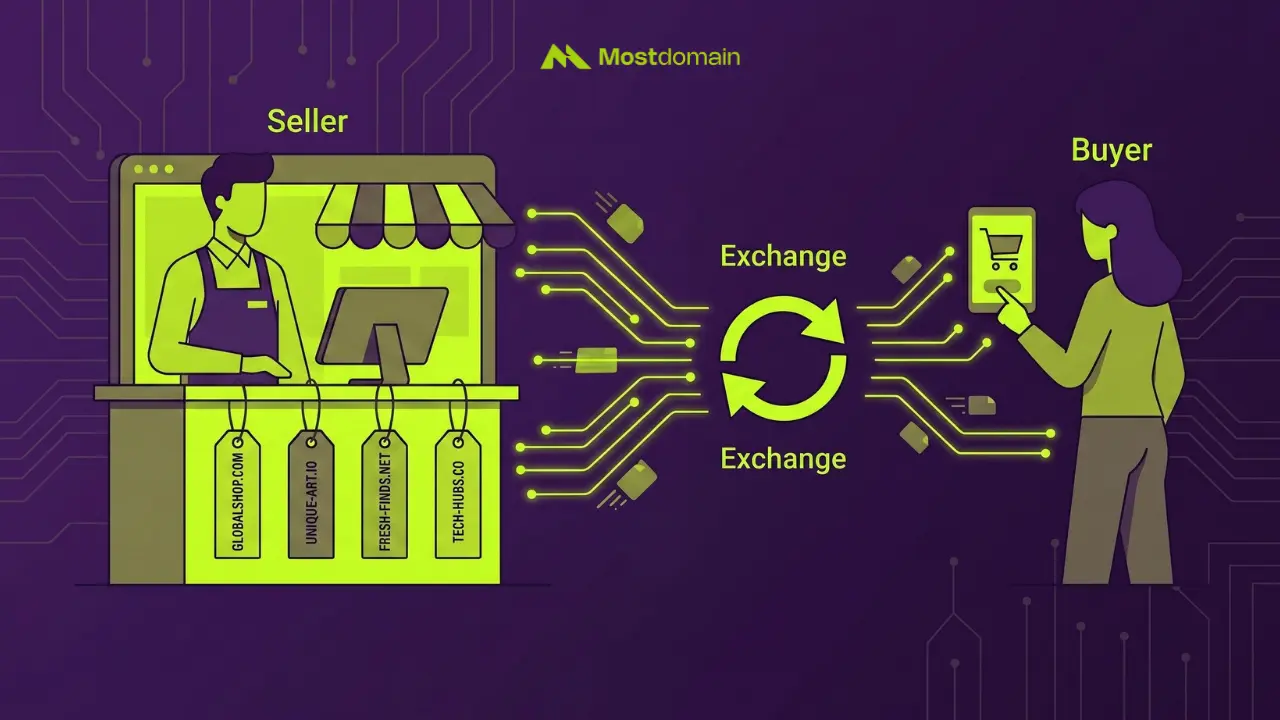
Think trading floor, not store shelf. A domain name marketplace is where owners list names for sale and buyers browse, negotiate, or bid on them, a dedicated exchange sitting apart from wherever domains actually get registered in the first place. Prices move on demand and negotiation, sometimes on competitive bidding, rather than sitting fixed at whatever number one seller decided to type in. The mechanics matter here more than which platform has the nicest homepage. Barely anything changes from one marketplace to the next once you get past the branding.
What Is a Domain Name Marketplace?
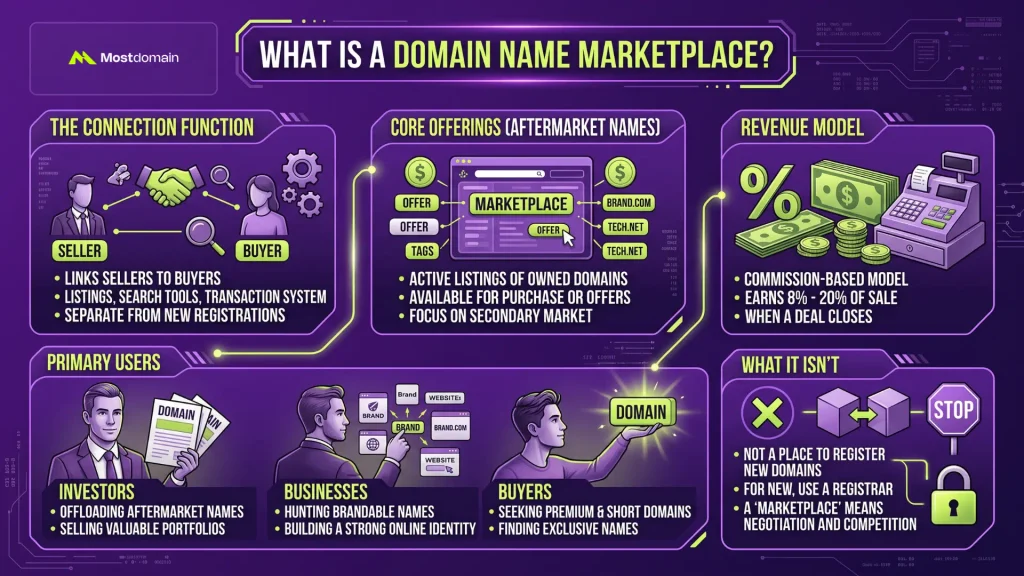
Connection is the whole function. A domain marketplace links sellers to buyers through listings, search tools, and a transaction system, separate entirely from a registrar’s actual job of registering new names that nobody’s owned before.
- Core function: active listings of domains someone else already owns, up for purchase or offer
- Revenue model: usually a commission when a sale closes, somewhere around 8% to 20% depending on the platform
- Primary users: investors offloading aftermarket names, businesses hunting one specific brandable name, buyers chasing premium or short domains that standard registration can’t offer
- What it isn’t: somewhere to register a brand-new domain nobody’s owned. Different job, different function, that’s a registrar’s territory
Call it a throwaway word and you’d be wrong. “Marketplace” signals negotiation and competition specifically, and that’s the exact thing separating this whole category from a plain purchase transaction.
How Does a Domain Name Marketplace Work?
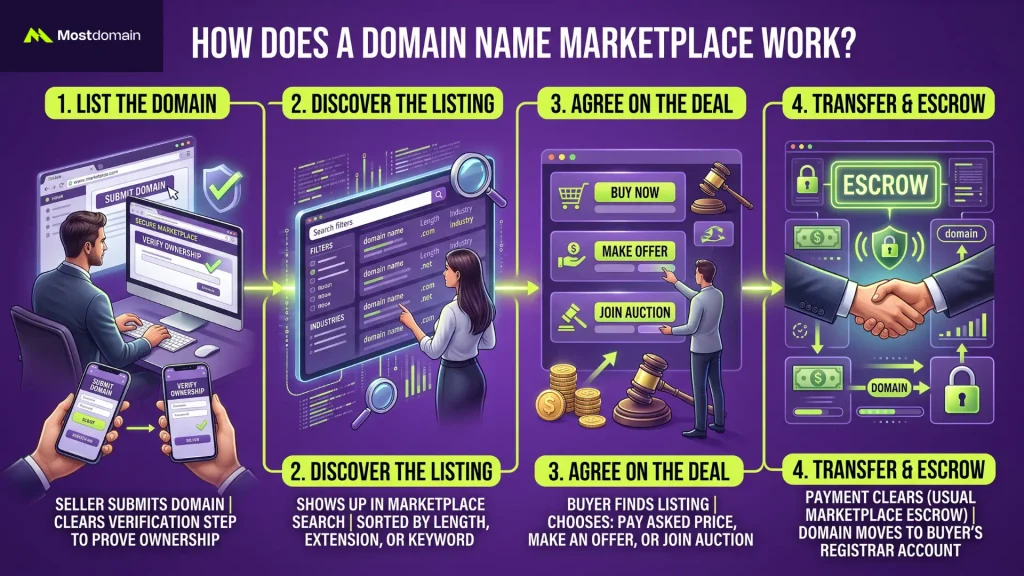
Four steps, one after another. List, discover, agree, transfer, that’s the whole cycle boiled down.
- A seller submits a domain for listing, sometimes clearing a quick verification step first to prove ownership.
- It shows up in the marketplace’s search index, occasionally sorted by length, extension, or industry keyword.
- A buyer stumbles on the listing and either pays what’s asked, throws out an offer, or jumps into an active auction.
- Payment clears, usually through the marketplace’s own escrow, and the domain lands in the buyer’s registrar account.
Reads simple on paper. Each step still carries its own mechanics worth understanding before any money actually moves.
How Listings Get Priced on a Domain Marketplace
Three pricing models cover nearly everything, and knowing which one you’re looking at changes your whole approach to the purchase.

| Pricing Model | How It Works | Best For |
| Fixed price (Buy It Now) | Seller sets one price, first buyer to pay gets the domain | Buyers who know exactly what a name is worth and want speed |
| Make an offer | Buyer submits a number, seller accepts, counters, or declines | Names without an obvious market price, room to negotiate |
| Auction | Multiple buyers bid within a set time window, highest bid wins | High-demand names where competitive pressure drives up value |
Auctions usually land closest to true market price since real buyers are actively competing against each other. They also just take longer to close than a straightforward fixed-price grab.
How Escrow Protects Domain Marketplace Transactions
A neutral third party holds the money, that’s escrow in one sentence. Payment sits there until the domain transfer confirms complete, protecting both sides from the other one bailing halfway through.
- Buyer sends payment to the escrow service, not directly to the seller
- Seller initiates the domain transfer once payment is confirmed as received by escrow
- Buyer confirms the domain has successfully transferred into their account
- Escrow releases the funds to the seller only after that confirmation
Skip escrow on anything above pocket change, and you’re one of the more common ways buyers and sellers end up getting burned. Most reputable marketplaces bake escrow directly into checkout anyway, so it’s rarely even something you have to remember to add.




How Domain Transfer Works After a Marketplace Sale
Ownership moves from the seller’s registrar account to the buyer’s. A few hours to a few days, typically, depending on which extension and which registrars are involved.
- The seller unlocks the domain and provides an authorization code (also called an EPP code)
- The buyer initiates a transfer request at their own registrar using that code
- The losing registrar has a window, often five days, to approve or reject the transfer
- Some marketplaces handle this entire process internally through a “push” transfer, skipping the EPP code step for domains already on a compatible registrar
Push transfers move faster, no doubt, and they’re simpler too. The catch: both parties need to sit on the same registrar, or at least one within the same marketplace ecosystem, or the whole thing just doesn’t work.
Marketplace or Registrar: Spotting the Difference
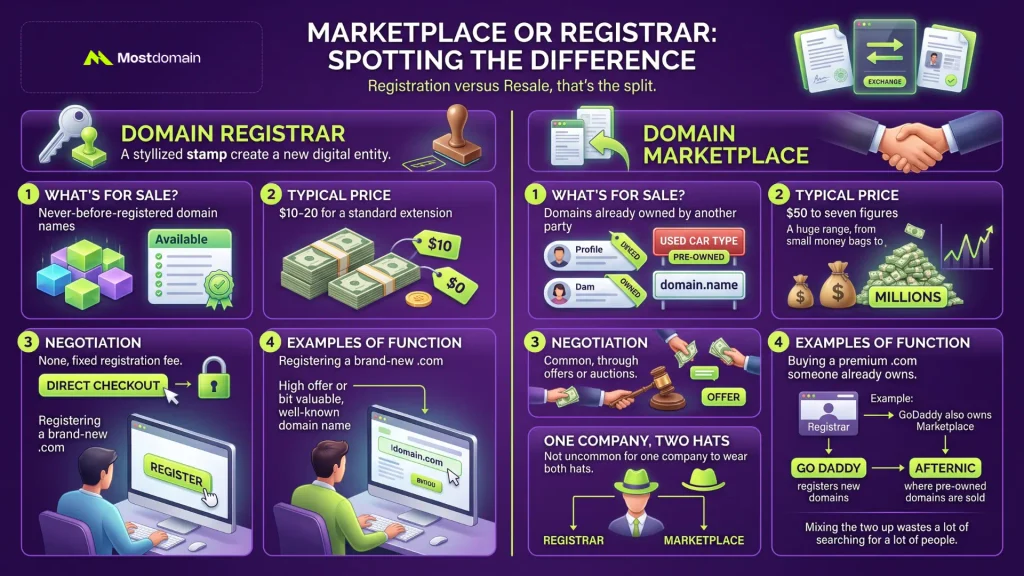
Registration versus resale, that’s the split. A registrar sells brand-new domain registrations straight from the pool of available names. A marketplace facilitates reselling domains someone already owns. Mixing the two up wastes a lot of searching for a lot of people.
| Aspect | Domain Registrar | Domain Marketplace |
| What’s for sale | Never-before-registered domain names | Domains already owned by another party |
| Typical price | $10-20 for a standard extension | Anywhere from $50 to seven figures |
| Negotiation | None, fixed registration fee | Common, through offers or auctions |
| Examples of function | Registering a brand-new .com | Buying a premium .com someone already owns |
Not uncommon for one company to wear both hats. GoDaddy handles brand-new registrations as a registrar, then turns around and owns Afternic too, an aftermarket marketplace tucked under that same corporate roof.
Four Types of Domain Name Marketplaces
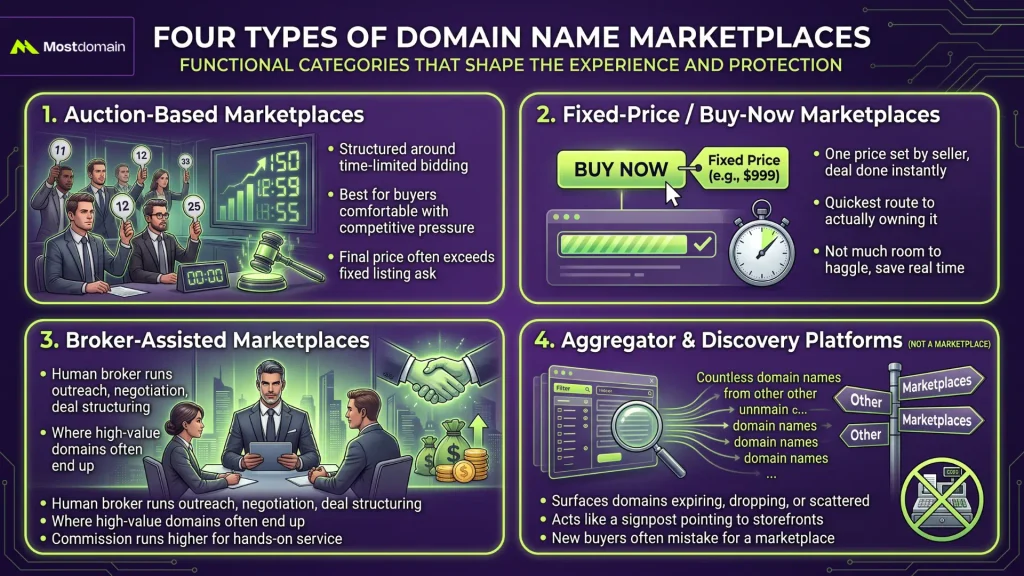
Four functional categories cover this space, and which one you’re using shapes the whole experience, protection included.
Auction-Based Marketplaces
- Structured around time-limited bidding on individual domains
- Best suited to buyers comfortable with competitive pricing pressure
- Final price often exceeds what a fixed listing would have asked
Fixed-Price / Buy-Now Marketplaces
- One price, set by the seller, deal’s done the second a buyer clicks accept
- Quickest route there is from browsing to actually owning it
- Not much room to haggle, but you save real time in exchange
Broker-Assisted Marketplaces
- A human broker runs the outreach, negotiation, and deal structuring for one side or both
- Where high-value domains usually end up, since two strangers negotiating directly tends to go nowhere
- Commission runs higher here, but that’s the cost of hands-on service
Aggregator & Discovery Platforms (Not the Same as a Marketplace)
These surface domains that are expiring, dropping, or scattered across other marketplaces entirely. What they skip is the actual transaction. Closer to a signpost than a storefront, really, pointing you toward where the real listing sits. Newer buyers mix this up with an actual marketplace more often than you’d expect.
How Much Do Domain Marketplace Fees Actually Cost?
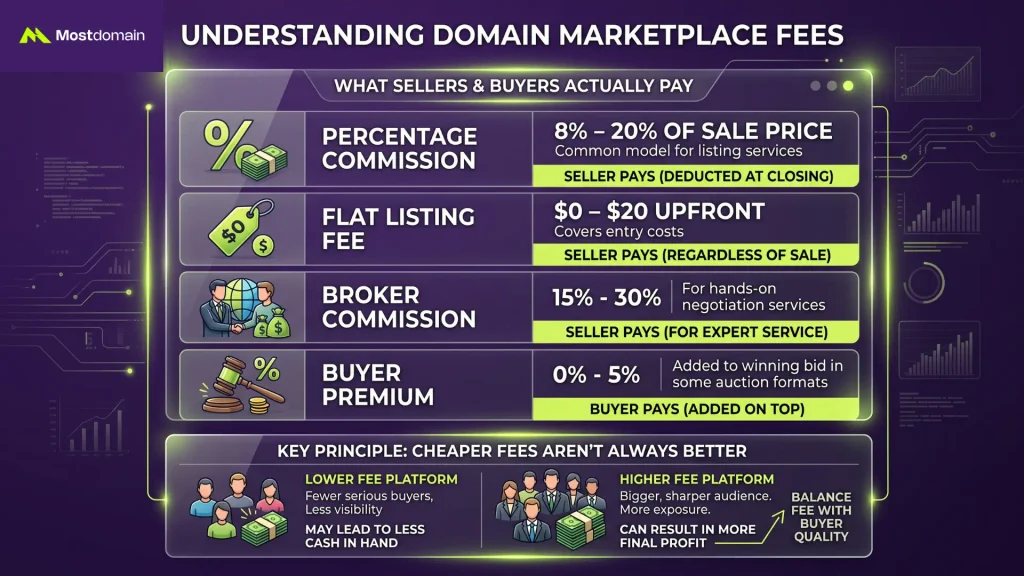
Somewhere between 8% and 20% of the sale price, and the seller’s the one covering it, though exact structure shifts depending on platform and deal size.
| Fee Structure | Typical Range | Who Pays |
| Percentage commission | 8%-20% of sale price | Seller, deducted at closing |
| Flat listing fee | $0-$20 upfront | Seller, regardless of whether the domain sells |
| Broker commission | 15%-30% | Seller, for hands-on negotiation service |
| Buyer premium | 0%-5% | Buyer, added on top of the winning bid in some auction formats |
Cheaper commission doesn’t automatically win, worth remembering. A platform shaving a few points off its fee but pulling in way fewer serious buyers can leave a seller with less cash in hand than a pricier platform sitting on a bigger, sharper audience.
Is Buying or Selling on a Domain Marketplace Safe?
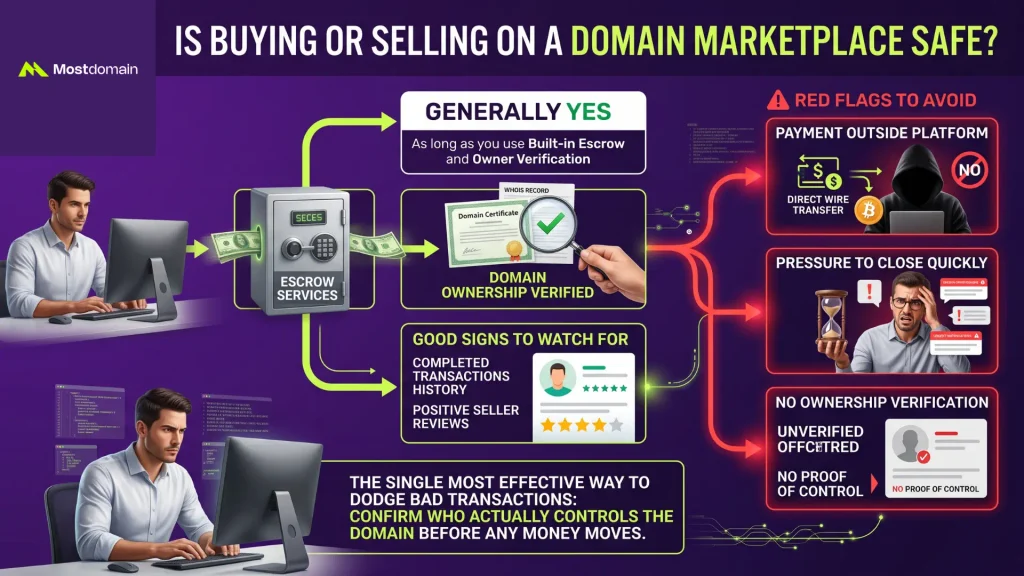
Generally, yes, as long as the deal runs through built-in escrow and actual ownership verification. Most horror stories start with someone trying to skip those exact safeguards to save a bit of time or a bit of money.
- Red flag: payment requested outside the platform. Any seller pushing for direct wire transfer or crypto payment off-platform is avoiding the exact protections escrow exists to provide
- Red flag: pressure to close quickly. Legitimate sellers rarely need a decision within the hour; urgency is a common manipulation tactic
- Red flag: no ownership verification offered. A seller unwilling to prove they actually control the domain, typically through a WHOIS or registrar-level check, shouldn’t be trusted with a wire transfer
- Good sign: transaction history or reviews. Established marketplaces usually show a seller’s completed transaction count or platform tenure
A few extra minutes confirming who actually controls a domain, before any money moves, that’s hands down the single most effective way to dodge a bad transaction.
How to Choose the Right Domain Marketplace for Your Needs
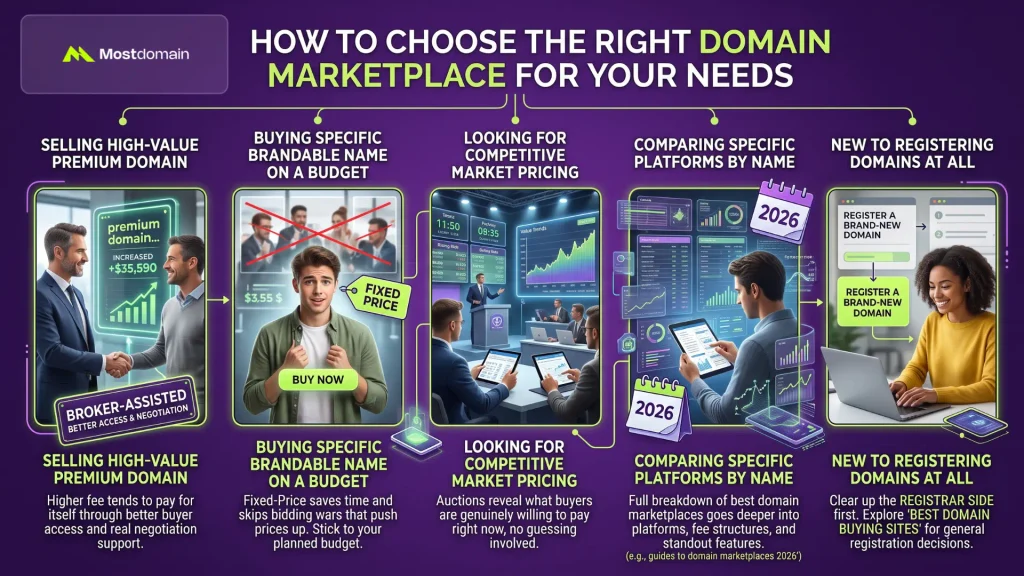
Comes down to what’s changing hands, honestly, plus price range and how much hands-on help you actually want.
- Selling a high-value premium domain: the higher fee on a broker-assisted marketplace tends to pay for itself through better buyer access and real negotiation support
- Buying a specific brandable name on a budget: fixed-price saves time and skips the bidding wars that push a price up past what you’d planned to spend
- Looking for competitive market pricing: auctions reveal what buyers are genuinely willing to pay right now, no guessing involved
- Comparing specific platforms by name: a full breakdown of the best domain marketplaces available in 2026 goes deeper into individual platforms, fee structures, and standout features than a general overview like this one can
- New to registering domains at all, not just buying aftermarket names: the best domain buying sites clears up the registrar side of things first, before marketplace-specific decisions even enter the picture
A Brief History of the Domain Name Marketplace Industry
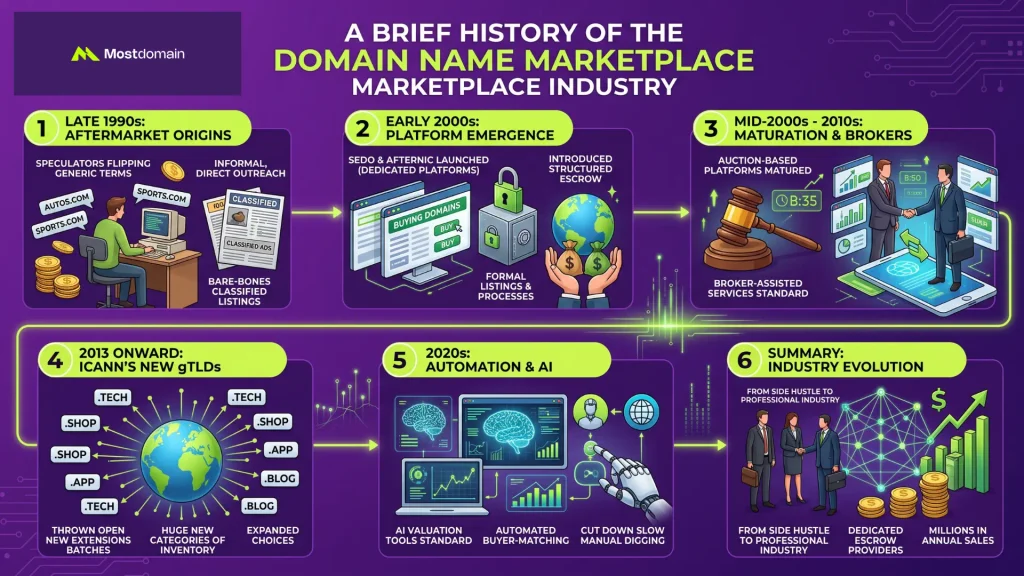
Speculators kicked this whole thing off. Domain marketplaces trace back directly to the late-1990s aftermarket, when people who’d grabbed generic terms early started looking for structured ways to flip them for profit.
- Late 1990s: flipping happened informally back then, mostly direct outreach and bare-bones classified-style listings
- Early 2000s: Sedo and Afternic launched as dedicated platforms, bringing structured escrow and formal listings into the picture for the first time
- Mid-2000s to 2010s: auction-based platforms matured, and broker-assisted services became standard for six and seven-figure domain sales
- 2013 onward: ICANN’s new gTLD program threw open a huge batch of new extensions, handing marketplaces whole new categories of inventory to work with
- 2020s: AI valuation tools and automated buyer-matching became standard features across the bigger platforms, cutting down what used to be slow, manual digging
What began as a scrappy side hustle for early internet speculators is now a real industry, dedicated escrow providers, professional brokers, platforms moving millions of dollars in domain sales every single year.
Domain Marketplace Glossary
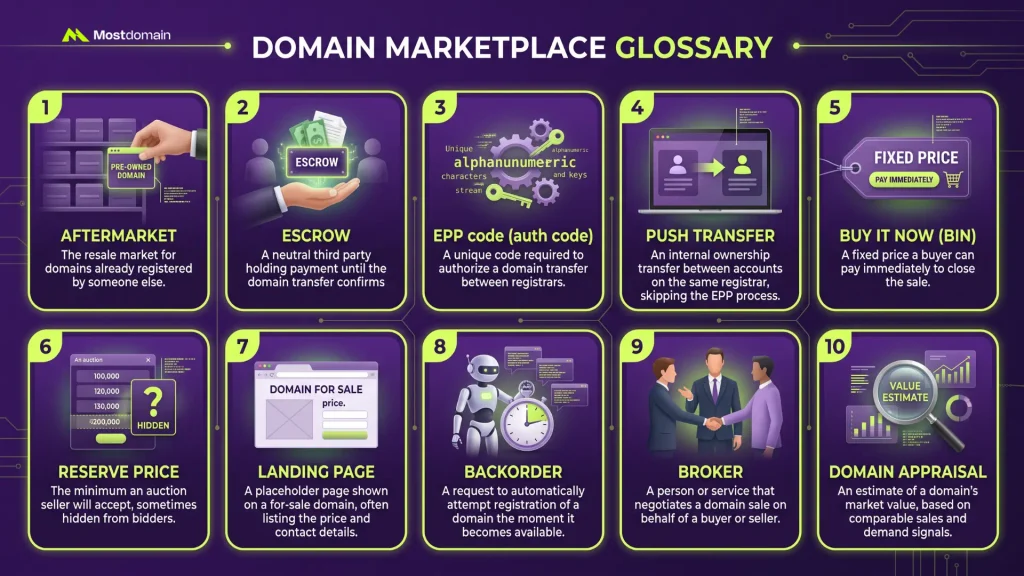
Ten terms, and they cover almost every word you’ll bump into on a listing page across nearly any marketplace.
| Term | Plain Definition |
| Aftermarket | The resale market for domains already registered by someone else |
| Escrow | A neutral third party holding payment until the domain transfer confirms |
| EPP code (auth code) | A unique code required to authorize a domain transfer between registrars |
| Push transfer | An internal ownership transfer between accounts on the same registrar, skipping the EPP process |
| Buy It Now (BIN) | A fixed price a buyer can pay immediately to close the sale |
| Reserve price | The minimum an auction seller will accept, sometimes hidden from bidders |
| Landing page | A placeholder page shown on a for-sale domain, often listing the price and contact details |
| Backorder | A request to automatically attempt registration of a domain the moment it becomes available |
| Broker | A person or service that negotiates a domain sale on behalf of a buyer or seller |
| Domain appraisal | An estimate of a domain’s market value, based on comparable sales and demand signals |
FAQ
What is the difference between a domain marketplace and a domain auction site?
Think of an auction site as one flavor within the bigger category. It’s built specifically around competitive, time-limited bidding. “Domain marketplace” as a whole is broader, covering fixed-price platforms and broker-assisted services too, ones that never touch an auction format at all.
Can I sell a domain without using a marketplace?
Happens all the time, actually, direct sales through personal outreach, forums, or existing business relationships. What you give up is the built-in escrow protection and the buyer traffic a marketplace already brings. That’s exactly why most sellers still push actual payment through a third-party escrow service, even after finding the buyer entirely on their own.
How long does a typical domain marketplace sale take to close?
Fixed-price sales can wrap up within minutes of a buyer deciding to pull the trigger. Auctions run on a set schedule, commonly 5 to 7 days. Broker-assisted sales for high-value domains often stretch several weeks to a few months, mostly because they involve real back-and-forth negotiation.
Do domain marketplaces work for buying, selling, or both?
Both, pretty much always. Nearly every marketplace supports listing a domain for sale alongside browsing domains to buy, a two-sided platform rather than a one-directional storefront.
Is it normal for domain marketplace fees to vary this much between platforms?
Normal, yes, and the gap usually maps to service level. Lower percentage tends to mean less hands-on support and a thinner buyer pool. Pay more for a broker-assisted service, and you’re generally getting more active outreach and negotiation muscle behind the sale.
How do I know if a domain’s asking price is fair before buying?
Comparable sales data for similar names is the most reliable place to start, and a domain value guide walks through the specific factors behind a fair valuation before you commit to an offer.
References
- Atom, “What Is a Domain Marketplace”
- ICANN, “New gTLD Program”
- Sedo, “Domain Marketplace History and Services”
- DomainSherpa, “Domain Name Marketplaces”
- Escrow.com, “How Domain Name Escrow Works”