
A pending delete domain has entered the final five-day countdown before a registry wipes it from its database and reopens it for public registration. During that window, nobody, not the registry, not the original owner, not a buyer with cash ready, can renew, transfer, or claim it. The only realistic way to actually acquire one is through an automated backorder or drop-catch service that fires a registration attempt the instant the name becomes available. Manual registration almost never works. Any name carrying real value gets contested by services running hundreds of registrar connections simultaneously.
What Does “Pending Delete” Actually Mean?
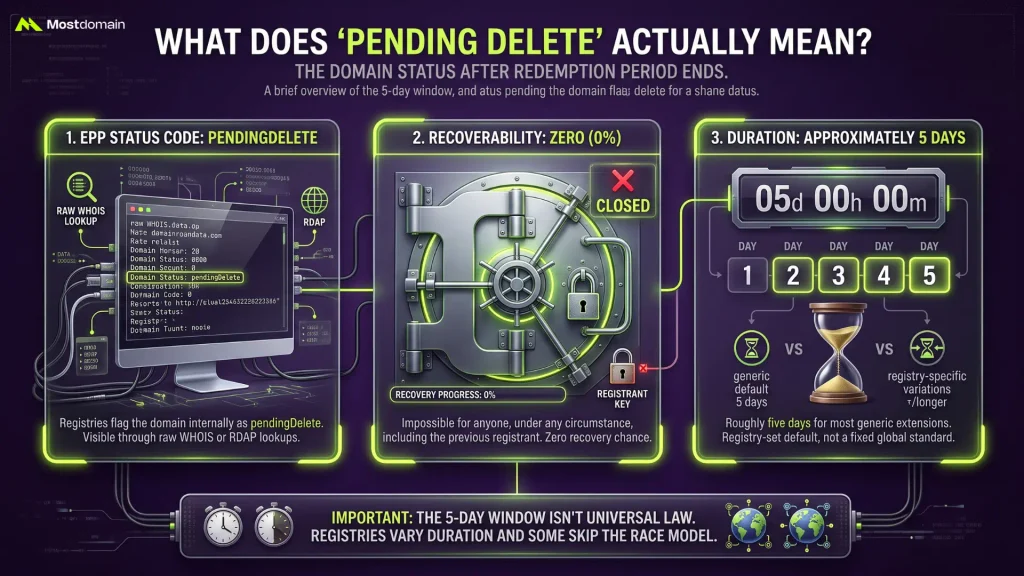
Pending delete is the status a domain holds for roughly five days after its redemption period ends, and recovery is impossible for anyone during that window. Three facts define the status, and they matter more than memorizing the exact day count.
- EPP status code: registries flag the domain internally as pendingDelete, visible through a raw WHOIS or RDAP lookup
- Recoverability: zero, for anyone, under any circumstance, including the previous registrant
- Duration: roughly five days for most generic extensions, though this is a registry-set default rather than a fixed global standard
That five-day window isn’t universal law. Some registries shorten it, some extend it, and a handful skip the race-based model entirely. For the fuller picture of what happens before a domain ever reaches this point, the grace period and redemption period that precede it are covered in our domain lifecycle guide.
Why Winning a Drop Is a Race, Not a Purchase
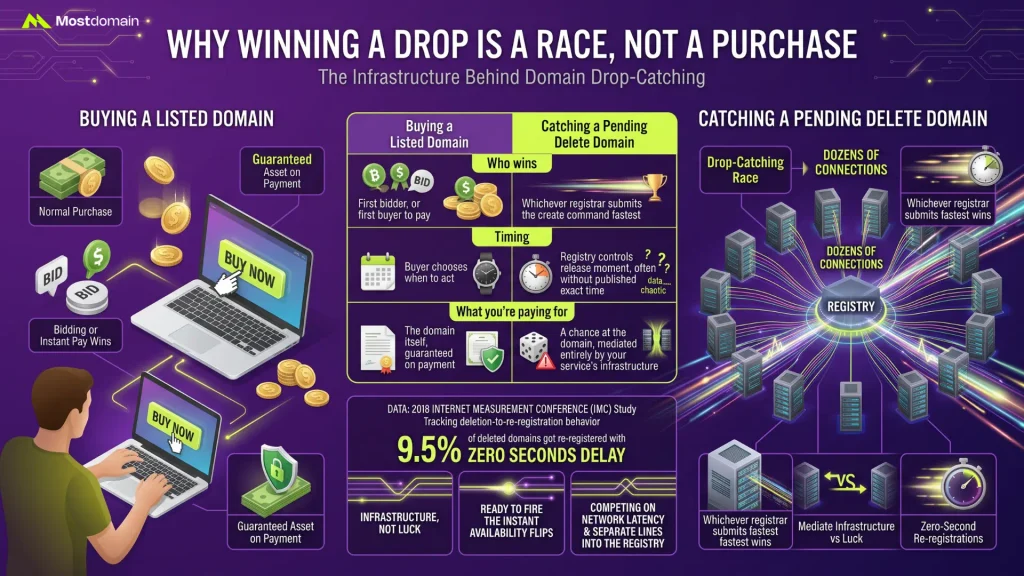
When a domain finally gets deleted, the registry opens a narrow availability window every accredited registrar can query at once, and the name goes to whichever system submits its registration command first, often by a margin of milliseconds. That’s a fundamentally different transaction than a normal purchase.
| Aspect | Buying a Listed Domain | Catching a Pending Delete Domain |
| Who wins | Highest bidder, or first buyer to pay | Whichever registrar submits the create command fastest |
| Timing | Buyer chooses when to act | Registry controls the release moment, often without a published exact time |
| What you’re paying for | The domain itself, guaranteed on payment | A chance at the domain, mediated entirely by your service’s infrastructure |
A 2018 Internet Measurement Conference study tracking deletion-to-re-registration behavior found that 9.5% of deleted domains got re-registered with zero seconds of delay. Not within a minute. Zero. That’s infrastructure, not luck: dozens of registrar connections polling the registry continuously, ready to fire the instant availability flips. You’re not really competing on price at this stage. You’re competing on network latency and how many separate lines into the registry your chosen service actually holds.
How Drop-Catch Services Actually Win
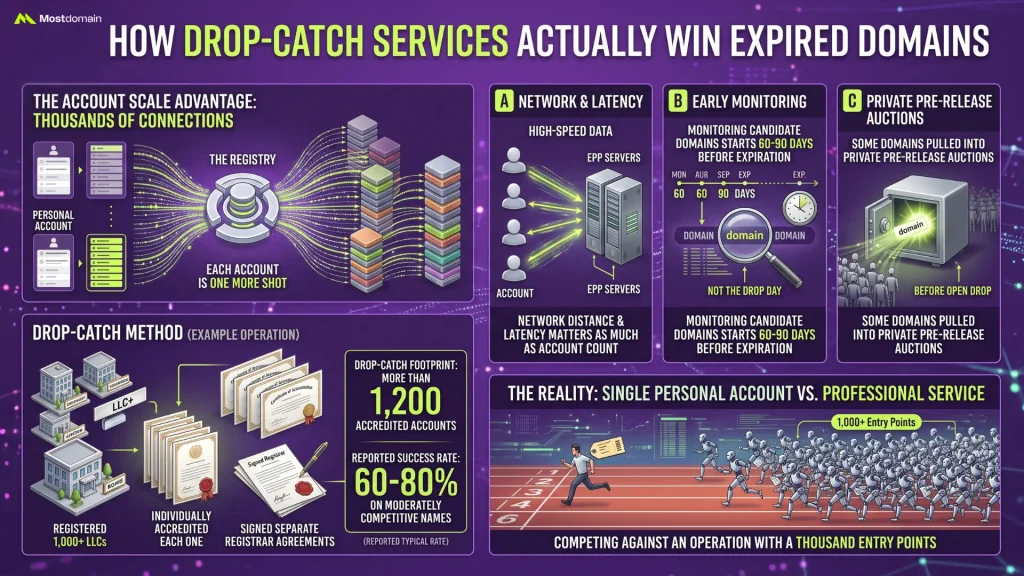
Professional drop-catch services win by holding hundreds or thousands of accredited registrar accounts, since the registry treats each account as a separate connection, and every connection is one more shot at the same domain. DropCatch built its reputation exactly this way, registering over 1,000 limited liability companies, getting each one individually accredited, and signing a separate registrar agreement for every single one.

- Recent data puts DropCatch’s footprint at more than 1,200 accredited registrar accounts, with a reported 60 to 80 percent success rate on moderately competitive names
- Network distance and latency between those accounts and the registry’s EPP servers matters as much as the raw account count
- Serious operations start monitoring candidate domains 60 to 90 days before expiration, not the day they actually drop
- Some domains get pulled into a private pre-release auction before ever reaching the open drop at all
Someone running a single personal backorder account is, realistically, competing against an operation with a thousand entry points into the same race.
Comparing Backorder Services
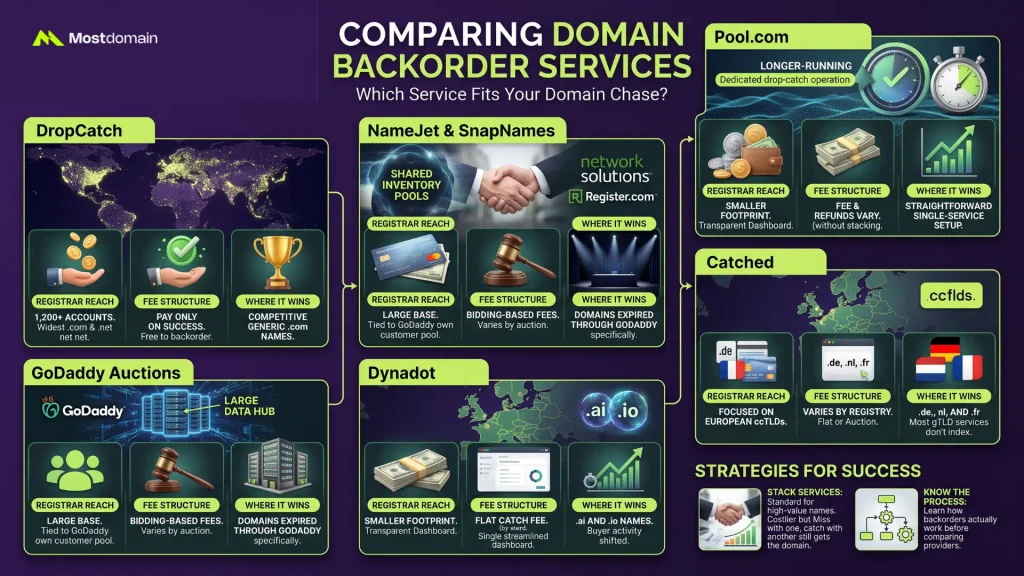
No single backorder service wins every drop, since each one built its infrastructure around a different registry relationship, TLD focus, or fee model. The right choice depends entirely on what you’re actually chasing.
| Service | Registrar Reach | Fee Structure | Where It Wins |
| DropCatch | Over 1,200 accredited registrar accounts, the widest net in .com and .net | Free to place a backorder; you only pay on a successful catch | Raw odds on competitive generic .com names |
| NameJet & SnapNames | Shared inventory pools, direct partnerships with Network Solutions and Register.com | Backorder fee charged upfront, non-refundable on a miss | Domains pulled into a private pre-release auction before the open drop |
| GoDaddy Auctions | Large registrar base tied to GoDaddy’s own customer pool | Bidding-based, fees vary by auction | Domains already expired through GoDaddy specifically, plus browsing without a dedicated backorder account |
| Pool.com | One of the longer-running dedicated drop-catch operations | Backorder fee, refund policies vary by plan | Buyers wanting a straightforward, single-service setup without stacking multiple accounts |
| Dynadot | Smaller registrar footprint, transparent dashboard | Flat catch fee, typically $15-25 depending on TLD | .ai and .io names, where buyer activity has shifted heavily over the past two years |
| Catched | Focused almost entirely on European ccTLDs | Varies by registry, some flat fee, some auction-triggered | .de, .nl, and .fr domains most gTLD-focused services don’t even index |
Stacking two or three of these on a single high-value name is standard practice among serious buyers. It costs more upfront, but a miss with one service and a catch with another still gets the domain. For anyone still unclear on how the reservation mechanism itself works before comparing providers, how a domain backorder actually works breaks down that process on its own.




How ccTLD Rules Differ From gTLDs
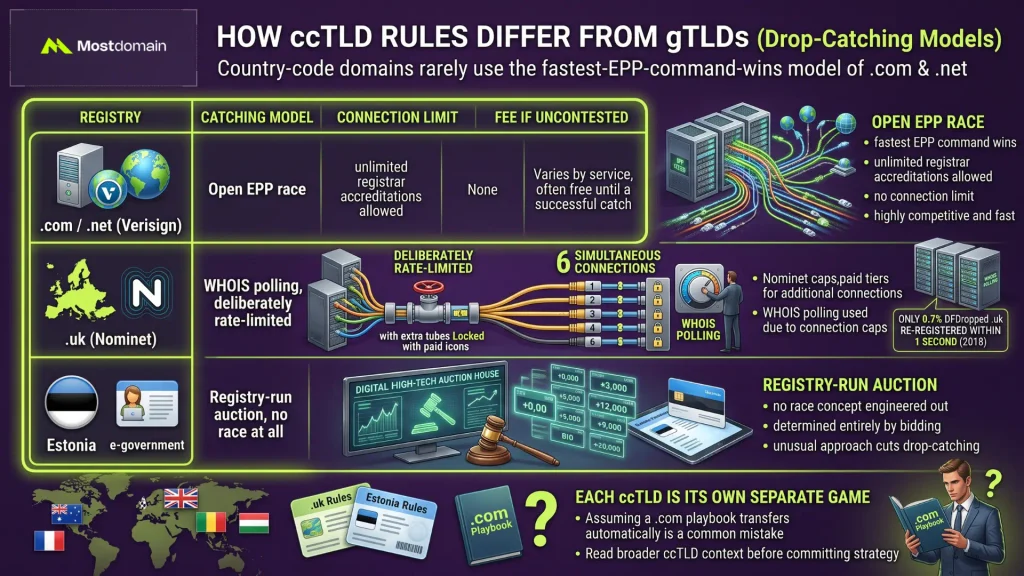
Country-code domains rarely follow the fastest-EPP-command-wins model that governs .com and .net, and at least one major registry has deliberately engineered the entire race concept out of its system.
| Registry | Catching Model | Connection Limit | Fee if Uncontested |
| .com / .net (Verisign) | Open EPP race, unlimited registrar accreditations allowed | None | Varies by service, often free until a successful catch |
| .uk (Nominet) | WHOIS polling, deliberately rate-limited | 6 simultaneous EPP connections per registrar, expandable for a fee | Around £35 flat |
| Estonia | Registry-run auction, no race at all | Not applicable | Determined entirely by auction bidding |
- The UK model: Nominet caps every registrar at six simultaneous EPP connections, with a paid tier allowing additional batches at extra cost. That cap is exactly why UK drop-catching leans on WHOIS polling rather than raw connection volume. Only about 0.7% of the roughly 1.76 million .uk domains that dropped in 2018 got re-registered within a second, a fraction of what happens in the unrestricted gTLD market.
- The Estonian model: rather than racing, Estonia auctions expired names directly at the registry level, cutting drop-catching out of the picture almost entirely. It’s an unusual approach, and one of the few registries doing it this way.
If your watchlist spans multiple TLDs, treat each ccTLD as its own separate game. Assuming a .com playbook transfers over automatically is one of the most common mistakes buyers make once they branch out. A broader look at how ccTLD domains work outside the drop-catching context is worth reading before committing to any single country-code strategy.
Finding Candidates Before They Reach Pending Delete
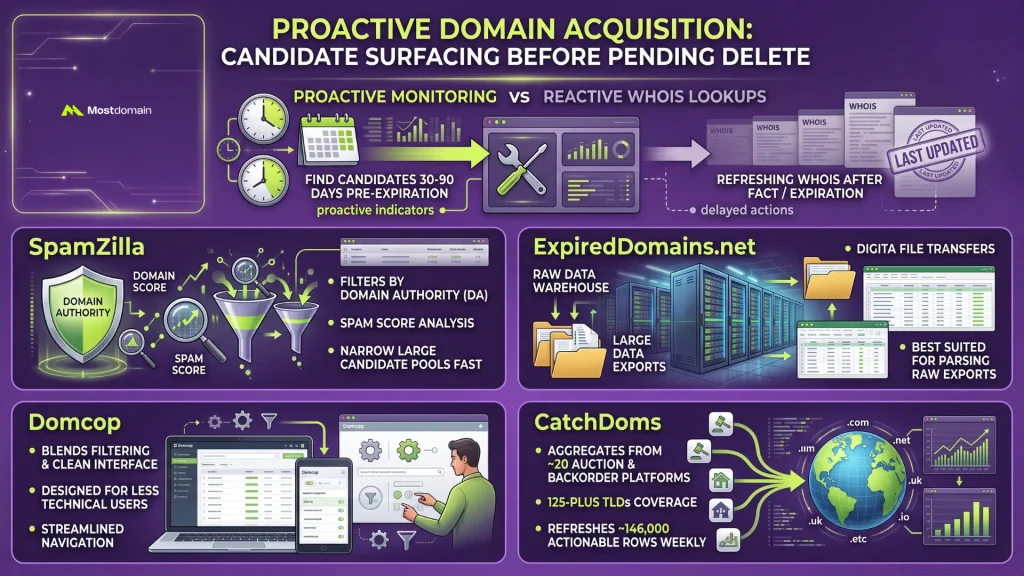
A watchlist that actually works depends on monitoring tools that surface candidates 30 to 90 days before expiration, not on refreshing a WHOIS lookup after the fact.
- SpamZilla filters by Domain Authority and spam score, useful for narrowing a large candidate pool fast
- ExpiredDomains.net functions more like a raw data warehouse, better suited to buyers comfortable parsing large exports
- Domcop blends filtering with a cleaner interface for less technical users
- CatchDoms aggregates listings from roughly 20 auction and backorder platforms across 125-plus TLDs, refreshing around 146,000 actionable rows weekly
Once a candidate is shortlisted, confirming its actual status code (redemptionPeriod versus pendingDelete versus already-deleted) matters more than its listed expiration date. A WHOIS lookup is the fastest way to check that status directly.
What Happens After You Win the Catch?
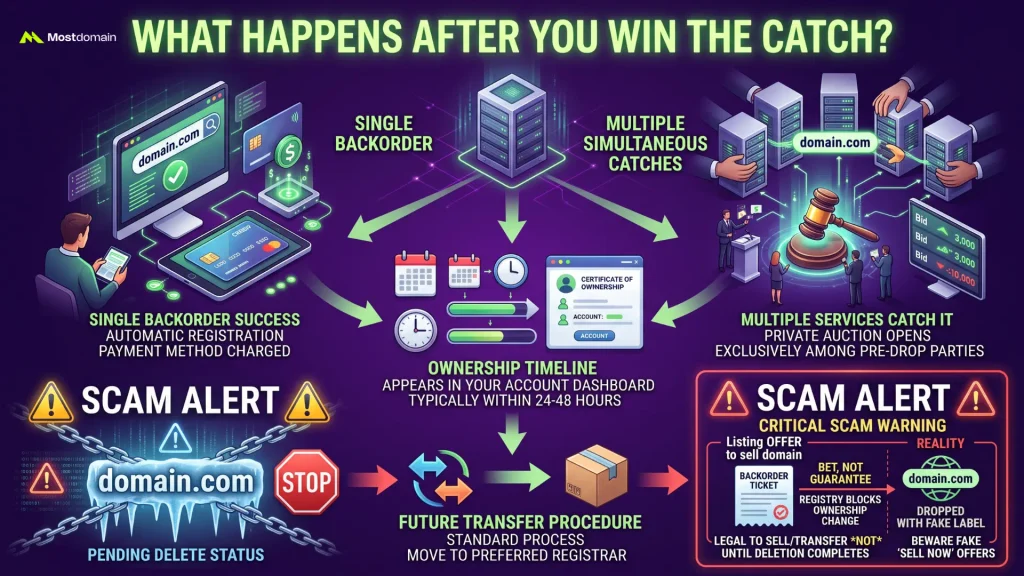
Winning a catch doesn’t end the process instantly, and if more than one backorder service catches the same domain at the same moment, it goes to a private auction rather than an automatic loss for either party.
- If you’re the only backorder on the domain, registration completes automatically and your default payment method gets charged.
- If multiple services caught it simultaneously, a private auction opens among only the parties who placed a backorder before the drop.
- Ownership typically shows up under your account within 24 to 48 hours of a successful catch.
- Transferring it to your preferred registrar afterward follows the same process as any other domain transfer.
One scam pattern is worth flagging directly: a domain legally cannot be sold or transferred to a new buyer while it’s still in pending delete status. The ownership record is frozen, and the registry blocks any change until deletion actually completes. If a listing offers to “sell you a pending delete domain right now,” what’s actually being sold is either a backorder slot, which is a bet rather than a guarantee, or a domain that already dropped and got mislabeled to sound more exclusive.
Is Chasing a Drop Actually Worth It?
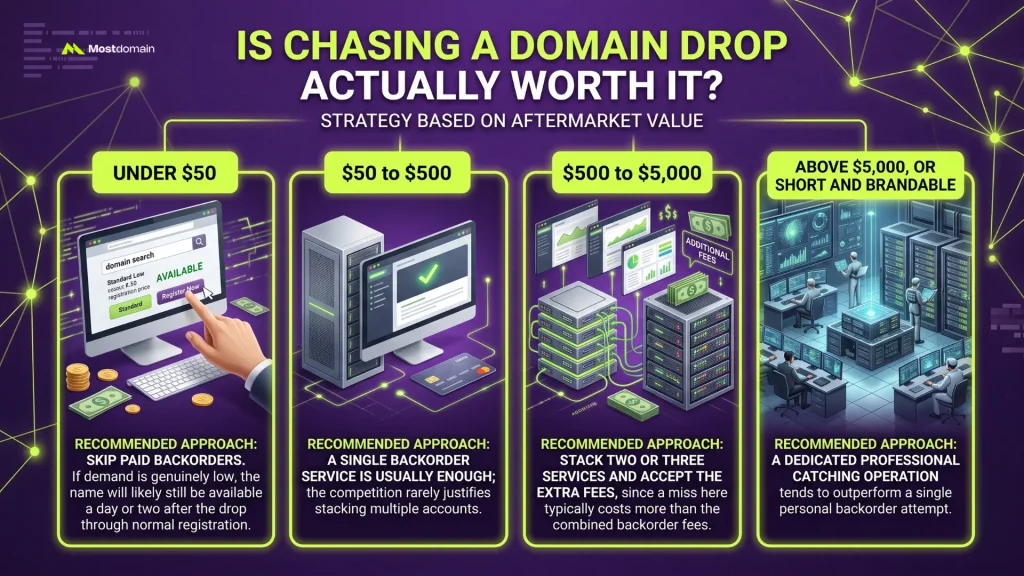
Whether a drop is worth chasing comes down almost entirely to the domain’s aftermarket value, since the fee-to-payoff math looks completely different at $50 than it does at $5,000.
| Aftermarket Value | Recommended Approach |
| Under $50 | Skip paid backorders. If demand is genuinely low, the name will likely still be available a day or two after the drop through normal registration |
| $50 to $500 | A single backorder service is usually enough; the competition rarely justifies stacking multiple accounts |
| $500 to $5,000 | Stack two or three services and accept the extra fees, since a miss here typically costs more than the combined backorder fees |
| Above $5,000, or short and brandable | A dedicated professional catching operation tends to outperform a single personal backorder attempt |
Setting Realistic Odds Before Spending on a Backorder
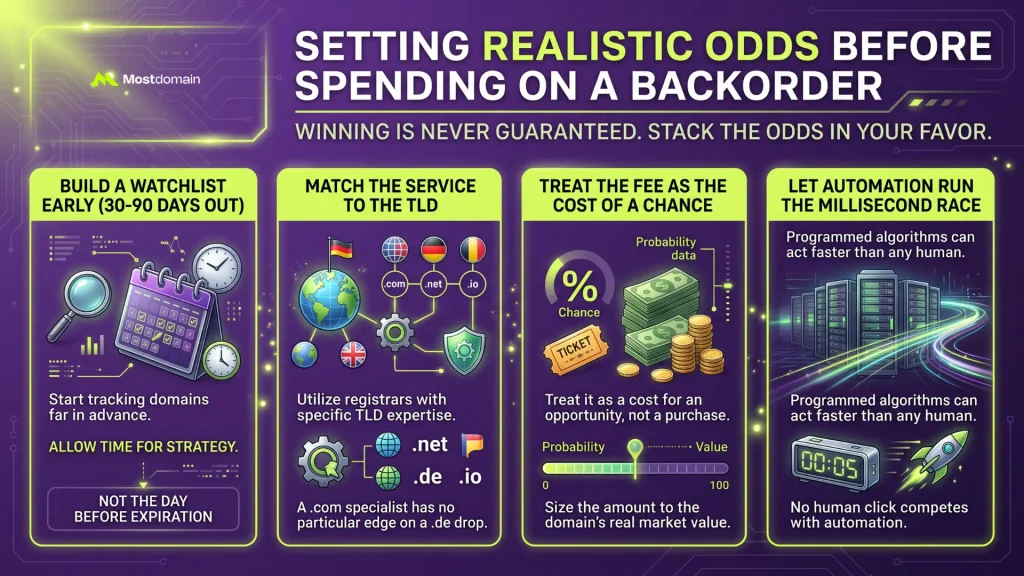
Winning any specific pending delete domain is never guaranteed regardless of which service gets paid, so the actual goal is stacking the odds enough that the expected payoff clears the fees.
- Build a watchlist 30 to 90 days out, not the day before expiration
- Match the service to the TLD; a .com specialist has no particular edge on a .de drop
- Treat the fee as the cost of a chance, not a guaranteed purchase, and size it to the domain’s real value
- Let automation run the millisecond race; no human click competes with it
FAQ
Can I buy a pending delete domain directly from the current owner?
No, not while it’s actually in that status. The registry freezes the ownership record and blocks any transfer request until deletion completes, so a direct sale isn’t technically possible during this window regardless of what a seller offers.
How long does pending delete actually last?
Five days is the standard window for most generic extensions, though this isn’t universal. Some country-code domains run shorter or longer holds, and .uk follows a fixed 90-day timeline from expiration to public availability rather than the grace-then-redemption-then-pending-delete structure gTLDs use.
What happens if two backorder services catch the same domain at once?
It goes to a private auction between whoever placed a backorder before the drop. Anyone who didn’t place a backorder in advance isn’t eligible to join that auction, regardless of budget.
Do all country-code domains use the same drop-catching system as .com?
Not even close. Nominet caps .uk registrars at six simultaneous EPP connections and relies on WHOIS polling instead of a pure speed race, while Estonia skips drop-catching altogether and auctions expired names directly through the registry.
Is stacking multiple backorder services worth the extra cost?
Depends heavily on the domain’s value. Below roughly $500 in aftermarket worth, one service is usually sufficient. Above that threshold, the cost of missing the domain typically outweighs the extra fees from a second or third service.
Can the original owner recover a domain once it reaches pending delete?
No. Recovery is only possible during the earlier redemption period, at a steep fee. Once pending delete begins, that door closes permanently, and the domain proceeds to deletion and public release regardless of any late attempt to renew.
References
- Internet Measurement Conference 2018 Proceedings (ACM Digital Library), “From Deletion to Re-Registration in Zero Seconds”
- Domain Name Wire, “Verisign Patent Suggests a New Model for Expired Domains”
- Domain Incite, “Nominet Wants to Kill Off the .uk Drop-Catching Market”
- Nominet, “Expired Domains Consultation”